Sunday, November 20, 2011

The Twelve Arachnids of Christmas!


Grab copies of the twelve books in my exciting ARACHNID WORLD series published by Lerner (2010-2011) to join in the fun. You see my true love is an arachnologist, someone who studies all kinds of arachnids. So this year my Christmas gifts were very different, but definitely ones I'll always remember.


On the first day of Christmas, my true love gave me to a black widow in a fir tree.


As I watched, that black widow spider dangled upside down from a silk thread. Next, its exoskeleton (armor-like covering) split open along the back. Then the spider pushed and pulled and crawled out of its exoskeleton.

What in the world just happened? To find out, read Black Widows: Deadly Biters pages 22 through 23.


On the second day of Christmas, my true love gave to me two striped bark scorpions--one big female 3 inches (7.5 cm) long and a smaller male.


As I watched, the male grabbed the female's pedipalps (body parts near the mouth). He tugged her forward and then they turned around in a circle. They did this over and over for hours.

What was happening to my scorpions? To find out, read Scorpions: Armored Stingers pages 28 and 29.


On the third day of Christmas, my true love gave to me three female
Carolina wolf spiders.


As I watched, a round ball about one-third as big as the spider and stuck to its spinnerets split open. Hundreds of tiny spiders crawled out and climbed onto the big spider.

What's likely to happen next? To find out, read Wolf Spiders: Mothers On Guard pages 26 through 29.


On the fourth day of Christmas, my true love gave to me four wind scorpions.


Almost at once, one of the wind scorpions ran straight up a nearly vertical rock. How did it keep from falling off? To find out, read Wind Scorpions: Killer Jaws pages 24 and 25.


On the fifth day of Christmas, my true love gave to me five tarantulas.


One goliath bird-eater tarantula was holding a gecko. As I watched it sank in its fangs and brought up digestive juices.

Why in the world did it do that? To find out read Tarantulas: Supersized Predators pages 32 and 33.


Then keep on reading quickly to let me know whether I should stay to watch or run away. Two of the other tarantulas have turned their hairy rear ends toward me and look ready to rub these with their hind legs.

Help me decide what action to take by reading pages 30 and 31.


On the sixth day of Christmas, my true love to me six female cross spiders spinning their webs.


As I watched, a fly landed on one spider's web. That female ran to the fly and shots strands of silk over it.

Why did she do that? To find out, read Orb Weavers: Hungry Spinners pages 24 and 25.


I kept on watching and saw a fly zip into another spider's web. I expected the web to break, but it didn't. Why not? To find out, read page 17 and page 22.


On the seventh day of Christmas, my true love gave to me seven fishing spiders fishing in a pond.


At just that moment, a bat flew past and all the fishing spiders dived beneath the surface. They stayed underwater for nearly thirty minutes.

How were they able to stay underwater for so long? To find out, read Fishing Spiders: Water Ninjas pages 22 through 23.


On the eighth day of Christmas, my true love gave to me eight crab spiders
lurking inside flowers.


Some goldenrod crab spiders were inside yellow flowers and they were yellow. Other goldenrod crab spiders were inside white flowers and they were white.

How were these spiders able to be just the right flower color to hide and wait to ambush insects? To find out, read Crab Spiders: Phantom Hunters pages 22 and 23.


On the ninth day of Christmas, my true love gave to me nine harvestmen packed close together and bobbing up and down.


Why were they doing that? To find out, read Harvestmen: Secret Operatives page 21.


On the tenth day of Christmas, my true love gave to me ten ticks-a-sucking blood from their host.


As I watched these female dog ticks over several days, their bodies swelled up until they were nearly six hundred times bigger.

How in the world could they swell so big? To find out read Ticks: Dangerous Hitchhikers pages 14 and 15.

Why can a tick's bite make people and animals sick? Read pages 28 through 36 to find out.


On the eleventh day of Christmas, my true love gave to me eleven jumping spiders jumping.


As I watched, one leapt from one leaf to another to catch an insect.

How could it possibly jump so far? To find out, read Jumping Spiders: Gold Medal Stalkers pages 22 and 23.

What's the record for how far a jumping spider can leap? Read pages 46 and 47 to find out.


On the twelfth day of Christmas, my true love gave to me twelve mites-a-multiplying
on a bean plant.


At first, I couldn't see the tiny two-spotted mites sucking on one of the plant's leaves. In less than a month, the plant was nearly covered with web strands dotted with tiny mites. They were sucking the plant's juices and producing even more two-spotted mites.

How did there get to be so many so quickly. To find out, read Mites: Master Sneaks pages 36 and 37.

Yes, my arachnid Christmas this year is one I'll always remember. After all, it's the year I received:

12 mites-a-multiplying
11 jumping spiders jumping
10 ticks-a-sucking
9 harvestmen bobbing
8 crab spiders lurking
7 fishing spiders fishing
6 orb weavers spinning
5 tarantulas
4 wind scorpions
3 wolf spiders
2 scorpions
And a black widow in a fir tree

Monday, November 7, 2011

Get Wild For Wild Horses


Moving to a new place can mean adjusting to a very different way of life. That’s what happens to the horses in my book, Race the Wild Wind (Bloomsbury Publishing, 2011). These activities will let children dig deeper into the story, think about what such a major life change is like, and get to know the real Sable Island Horses that inspired the book.

First of all, this story is set on a real place, Sable Island. Look just inside the book’s cover. You’ll find a map that shows you where this island is located off the coast of Nova Scotia on the east coast of Canada.


The heart of this story is about adjusting to a new place and way of living. Find this picture in the book. Then read the story to find out how life changed for one young stallion. Next, talk about and then write about a time you moved someplace new or that something about your life changed.

*What changed for you?

*What about that change was especially hard for you?


Find this picture in the book. As you read, you'll discover the horses didn't know each other when they first came to the island. What changed as they did get to know each other? Why do you think the stallion sometimes ran as fast as he could?


Read what happened to the young stallion when he broke through the ice to get a drink of water. Why was this an important change in his life?


The horses living on Sable Island did’t have any natural predators, such as wolves or mountain lions. However, living there was sometimes dangerous. Read the story to find at least three things that made life challenging—even deadly.


Verbs are powerful words. Action verbs—ones that make you feel the action you’re reading about—make a story much more exciting.

For example, check out some of the action verbs that bring Race the Wild Wind, to life.
“Barking and wriggling, the seals stampede into the surf.”
“Storms claw at beaches and dunes.”
“Stinging rain pelts down. Waves charge ashore.”


Find at least two more places action verbs ramp up the story.
Clues:

You’ll find one where the horses are swimming ashore as the ship sails away.

You’ll find another where the young stallion goes after the colt in the blinding fog.


Of course, there are many more action verbs in this exciting story.


Now enjoy pictures of the real wild horses living on Sable Island today. Then make up your own story about the life of one special horse--one that’s just been born. Be sure and use action verbs to power up your story.


Monday, October 17, 2011

Soaring like Eagles--Share The Adventure


Soaring like Eagles is an action-packed adventure that will take you, along with 12-year-old Kate, into the remote wilderness of Snowbird Mountain in North Carolina--the heart of the Cherokee Nation. In discovering a grandfather she didn't know she had, 12-year-old Kate also finds a new life that’s far different from anything she ever dreamed of--and life-threatening danger from poachers.


When you're ready, download the book and start reading to jump into the adventure. For an extra fun challenge, find the answers to each of the questions as you share the action with Kate.


Kate wanted to try and find her grandfather. She needed $52.49 for a bus ticket to Cherokee, North Carolina.

She only had $11.00 of her own money.

How did she, little-by-little collect the additional money she needed for her trip.


What two reasons did Kate give for getting a round trip bus ticket to Cherokee instead of a one-way ticket?


This German shepherd, named Nvya, is an important character in the story.

How did he react to Kate at first?

What did Kate do to try and make friends with Nvya?

When did Nvya first begin to accept Kate?

At what point do we know Nvya has fully accepted Kate?


BONUS CHALLENGE:Now, outline Kate's developing relationship with her grandfather starting with how they felt about each other when they first met until they really felt like family.


These are leaves from a sassafras tree. Why was it so important for Kate to find and collect these leaves after her grandfather Tsan was shot?


Take a peek inside Tsan's mountain cabin. Imagine trading living in your home for living in this house. Did you notice that there isn't any television? Kate didn't even have a bed. She had to sleep in front of the fire. Make list of all the ways living in Tsan's house was very different for Kate.


This is the mountain stream near Tsan's cabin. It's where Kate caught fish and went to think when she needed time alone.


At first, she's afraid of being alone at night in the forest. Later, she feels quite at home.

What do you think changed?

What would you like, if anything, about moving to such a wilderness place?

What would you really miss about where you live? What does Kate miss most?


Describing something by showing how it’s like something else that’s familiar is called a metaphor. It’s a powerful way to paint pictures with words.


“The sun was already a fat orange ball hanging just above the mountain’s peak.”

This is how Kate described the day when she first met her grandfather. What does that word picture tell you about the time of day?


Find at least two more metaphors in the story.


Clues: You’ll find one describing Tsan’s cabin.


You'll find another when Kate describes how the pine tree trunks look in the fog the morning after the storm, her first morning on Snowbird Mountain.


*Ready to tackle a BIG challenge?

Then look at the events in the timeline below the picture.

This list tells what happened when Kate and her wounded grandfather, with Nvya's help, escaped the young Cherokee poacher.


But the list is out of order. You'll need to decide what happened first, second, and so forth.


*Kate and Tsan went along the narrow ledge to the cave.

*Nvya, the German shepherd, chased the chicken to draw the poacher away from the cabin.

*Kate, Tsan and Nvya head through the forest to Soquah’s house.

*Kate, Tsan, and Nvya stayed inside the cave until it was dark.

*The Indian attacks Kate.

*Father Paul comes to the rescue.

*Kate made a hole in the floor and crawled out to watch the young Indian.

*Nvya attacks the poacher to defend Kate.

*Kate runs to Tsan’s cabin.

*The young Indian catches Kate.

*Tsan leaves Kate alone in the forest.


This eaglet, nicknamed Baby, becomes another important character in the story.

How did rescuing the eaglet help Kate develop a relationship with her grandfather?


A myth is a story to explain how something in the world began.


Tsan tells the Cherokee myth of how a spider helped all of the animals of the world get fire and warm up.

Search the following on-line sites for other Cherokee myths.
http://www.sacred-texts.com/nam/cher/motc/

Website One

Website Two

After reading some of these myths make up one of your own to explain how one of the following came to be:


Hurricanes


Corn


What did Tsan see in the sky the day Baby made her first flight? What did he decide he had to do?


It's time for the exciting climax of the story.

Read and enjoy.

Then tell in what order did the events happened


*Kate climbed up the inside of the fireplace chimney

*The poachers set Tsan’s cabin on fire

*Kate jumped to the ladder dangling from the helicopter

*Tsan and Kate tried to beat out the flames and stop the fire

*Part of the cabin roof crashed in


Books end but stories never do.

They spark your imagination with ideas about what must have happened afterwards.

Imagine what may happened to Kate, Tsan, Baby, and Nvya in the year after the story ends.

Write a short story about what happens after the end of Soaring like Eagles.

Saturday, October 8, 2011

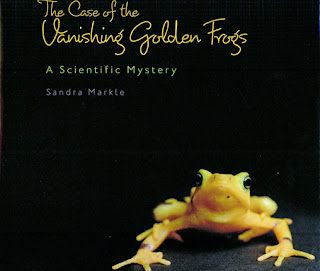
Help Solve The Case of the Vanishing Golden Frogs


Frogs of the world need you to be a science detective and help solve a scientific mystery. Scientists investigate real world problems and work to find solutions. Right now, scientists are working on The Case of the Vanishing Golden Frogs (Millbrook, 2011). They're after a serial killer--one guilty of killing so many frogs that some kinds no longer exist outside of safe places, like zoos.


So if you're ready to join the science detective task force for this case, check out a copy of the book and dig in.

Can you identify the killer in time to save the Panamanian golden frogs?

Can you find a way to stop this killer before even more kinds of frogs become victims?


Karen Lips discovered the first frog victims. Read pages 6 and 7 to find out:

1) When did she make this discovery?
2) Where in the world were the bodies?
3) Why was it important that the dead frogs were not decayed?

Just as detectives get help from a Medical Examiner, Karen Lips turned to a pathologist, someone who studies diseases.


Here's the clue the pathologist discovered when he looked at a sample of the frog victim's skin with a microscope. Check it out on page 8. He reported that it wasn't like anything he'd ever seen before.


So Karen Lips decided to check out the three usual suspects that kill animals:

*Habitat (home territory) Destruction

*Pollution

*Climate Change


Keep on reading to investigate and learn the answers to following questions.


What kind of habitat do Panamanian golden frogs need to be healthy? Find out on pages 10 and 11.


Why was habitat destruction proved not guilty of killing the golden frogs? Find out on page 9.


Why would polluted streams be a big problem for adult golden frogs?

Why would polluted water be especially bad for tadpoles, baby golden frogs?


Before you decide, visit this site to see the stages a frog goes through from egg to adult.


Why did Karen decide water pollution definitely wasn't killing the golden frogs?
See page 12.


What two things did Karen Lips then check out to prove climate change wasn’t the frog killer? Check page 14.


Joyce Longcore finally identified the frog killer as a chytrid fungus, a kind of plantlike living things. What did she see that let her figure out this was the killer? Dig into this on pages 18 and 19

Because she was the first to identify this new kind of chytrid fungus, Joyce was allowed to name it. She called it Batachochytrium dendrobatidis--Bd for short.


Now that the killer's identity is known, your job is to stop it from killing more golden frogs.


So you'll need to find out these two things about how this killer attacks its victims? Use the clues you've already discovered to answer these questions.

1) Who's more at risk--adult golden frogs or tadpoles?

2) In what kinds of environmental conditions is Bd most likely to kill?


Armed with that profile of the killer you can help the scientific SWAT team save Panamanian golden frogs from being killed by Bd.


Read pages 32 through 38 to find out which of the steps listed below needs to be done first, second, third, and so forth.

*Carry golden frogs in plastic bags to cleaning sites.
*Ship healthy frogs to zoos with special golden frog habitats.
*Breed golden frogs in zoo habitats to maintain the golden frog population.
*Collect both male and female golden frogs from their wild habitat.
*Treat captured golden frogs with a fungus-killing chemical for ten days.


What are two things being done to try and wipe out chytrids so frogs can be safe in the wild? Explore pages 40 and 41.


Brainstorm other possible things you think could be tried to make frogs safe from chytrids in the wild. Come up with at least two possibilities. List why these ideas might work? Suggest any possible reasons these ideas might not work.

Now, it's time to use what you've learned to launch OPERATION SAVE OUR FROGS.
First, find out what kinds of frogs, such as bullfrogs or leopard frogs, live in your area. Ask a local park ranger, someone at the local library, or someone at a local zoo.


Bullfrog


Leopard frog


Next, learn more about each kind of local frog and make a booklet with a chapter for each local kind of frog. Draw and color a picture of it. Also tell the following information:

*How big is an adult?
*What does it eat as an adult? As a tadpole?
*What kind of conditions does it need to live as an adult? As a tadpole?

Find out if chytrids are a problem locally and, if so, what can be done to protect the frogs. Would one of the ideas you had for getting rid of chytrids possibly work? If you think it would, share your idea with someone in your local environmental protection agency or with your teacher.


Also, check whether local frogs could be in danger from any of the usual suspects: habitat destruction, water pollution, climate change.


Search for the following clues:
1) Signs of habitat destruction, such as bare eroded land that was once green fields or forests.


2) Sources of water pollution, such as factories near rivers, streams, or lakes.

3) Evidence of climate change. To dig up information about this clue, interview your parents and grandparents. Ask if they remember your local climate being warmer or cooler or dryer or wetter in the past.

If you discover any of these clues, brainstorm with your friends and family and plan ways you can help your local frogs. Then work together to help local frogs stay safe.

Check out these efforts being done to save frogs around the world.

Are frogs worth so much detective work and effort?


Definitely! Without frogs there would be lots more insects in the world eating our food crops and spreading diseases to plants, animals, and people.


We need to solve The Case of the Vanishing Golden Frogs for the sake of Panimanian golden frogs, all the world's frogs--and for ourselves.

YOUR FREE GIFT FOR THE NEW SCHOOL YEAR

  Are you an elementary school Teacher, Librarian, or Media Specialist?  Then SANDRA MARKLE  invites you to become a Markle Book Explorer. I...