Monday, October 17, 2011

Soaring like Eagles--Share The Adventure


Soaring like Eagles is an action-packed adventure that will take you, along with 12-year-old Kate, into the remote wilderness of Snowbird Mountain in North Carolina--the heart of the Cherokee Nation. In discovering a grandfather she didn't know she had, 12-year-old Kate also finds a new life that’s far different from anything she ever dreamed of--and life-threatening danger from poachers.


When you're ready, download the book and start reading to jump into the adventure. For an extra fun challenge, find the answers to each of the questions as you share the action with Kate.


Kate wanted to try and find her grandfather. She needed $52.49 for a bus ticket to Cherokee, North Carolina.

She only had $11.00 of her own money.

How did she, little-by-little collect the additional money she needed for her trip.


What two reasons did Kate give for getting a round trip bus ticket to Cherokee instead of a one-way ticket?


This German shepherd, named Nvya, is an important character in the story.

How did he react to Kate at first?

What did Kate do to try and make friends with Nvya?

When did Nvya first begin to accept Kate?

At what point do we know Nvya has fully accepted Kate?


BONUS CHALLENGE:Now, outline Kate's developing relationship with her grandfather starting with how they felt about each other when they first met until they really felt like family.


These are leaves from a sassafras tree. Why was it so important for Kate to find and collect these leaves after her grandfather Tsan was shot?


Take a peek inside Tsan's mountain cabin. Imagine trading living in your home for living in this house. Did you notice that there isn't any television? Kate didn't even have a bed. She had to sleep in front of the fire. Make list of all the ways living in Tsan's house was very different for Kate.


This is the mountain stream near Tsan's cabin. It's where Kate caught fish and went to think when she needed time alone.


At first, she's afraid of being alone at night in the forest. Later, she feels quite at home.

What do you think changed?

What would you like, if anything, about moving to such a wilderness place?

What would you really miss about where you live? What does Kate miss most?


Describing something by showing how it’s like something else that’s familiar is called a metaphor. It’s a powerful way to paint pictures with words.


“The sun was already a fat orange ball hanging just above the mountain’s peak.”

This is how Kate described the day when she first met her grandfather. What does that word picture tell you about the time of day?


Find at least two more metaphors in the story.


Clues: You’ll find one describing Tsan’s cabin.


You'll find another when Kate describes how the pine tree trunks look in the fog the morning after the storm, her first morning on Snowbird Mountain.


*Ready to tackle a BIG challenge?

Then look at the events in the timeline below the picture.

This list tells what happened when Kate and her wounded grandfather, with Nvya's help, escaped the young Cherokee poacher.


But the list is out of order. You'll need to decide what happened first, second, and so forth.


*Kate and Tsan went along the narrow ledge to the cave.

*Nvya, the German shepherd, chased the chicken to draw the poacher away from the cabin.

*Kate, Tsan and Nvya head through the forest to Soquah’s house.

*Kate, Tsan, and Nvya stayed inside the cave until it was dark.

*The Indian attacks Kate.

*Father Paul comes to the rescue.

*Kate made a hole in the floor and crawled out to watch the young Indian.

*Nvya attacks the poacher to defend Kate.

*Kate runs to Tsan’s cabin.

*The young Indian catches Kate.

*Tsan leaves Kate alone in the forest.


This eaglet, nicknamed Baby, becomes another important character in the story.

How did rescuing the eaglet help Kate develop a relationship with her grandfather?


A myth is a story to explain how something in the world began.


Tsan tells the Cherokee myth of how a spider helped all of the animals of the world get fire and warm up.

Search the following on-line sites for other Cherokee myths.
http://www.sacred-texts.com/nam/cher/motc/

Website One

Website Two

After reading some of these myths make up one of your own to explain how one of the following came to be:


Hurricanes


Corn


What did Tsan see in the sky the day Baby made her first flight? What did he decide he had to do?


It's time for the exciting climax of the story.

Read and enjoy.

Then tell in what order did the events happened


*Kate climbed up the inside of the fireplace chimney

*The poachers set Tsan’s cabin on fire

*Kate jumped to the ladder dangling from the helicopter

*Tsan and Kate tried to beat out the flames and stop the fire

*Part of the cabin roof crashed in


Books end but stories never do.

They spark your imagination with ideas about what must have happened afterwards.

Imagine what may happened to Kate, Tsan, Baby, and Nvya in the year after the story ends.

Write a short story about what happens after the end of Soaring like Eagles.

Saturday, October 8, 2011

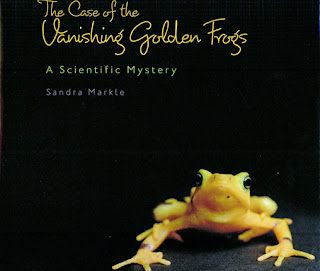
Help Solve The Case of the Vanishing Golden Frogs


Frogs of the world need you to be a science detective and help solve a scientific mystery. Scientists investigate real world problems and work to find solutions. Right now, scientists are working on The Case of the Vanishing Golden Frogs (Millbrook, 2011). They're after a serial killer--one guilty of killing so many frogs that some kinds no longer exist outside of safe places, like zoos.


So if you're ready to join the science detective task force for this case, check out a copy of the book and dig in.

Can you identify the killer in time to save the Panamanian golden frogs?

Can you find a way to stop this killer before even more kinds of frogs become victims?


Karen Lips discovered the first frog victims. Read pages 6 and 7 to find out:

1) When did she make this discovery?
2) Where in the world were the bodies?
3) Why was it important that the dead frogs were not decayed?

Just as detectives get help from a Medical Examiner, Karen Lips turned to a pathologist, someone who studies diseases.


Here's the clue the pathologist discovered when he looked at a sample of the frog victim's skin with a microscope. Check it out on page 8. He reported that it wasn't like anything he'd ever seen before.


So Karen Lips decided to check out the three usual suspects that kill animals:

*Habitat (home territory) Destruction

*Pollution

*Climate Change


Keep on reading to investigate and learn the answers to following questions.


What kind of habitat do Panamanian golden frogs need to be healthy? Find out on pages 10 and 11.


Why was habitat destruction proved not guilty of killing the golden frogs? Find out on page 9.


Why would polluted streams be a big problem for adult golden frogs?

Why would polluted water be especially bad for tadpoles, baby golden frogs?


Before you decide, visit this site to see the stages a frog goes through from egg to adult.


Why did Karen decide water pollution definitely wasn't killing the golden frogs?
See page 12.


What two things did Karen Lips then check out to prove climate change wasn’t the frog killer? Check page 14.


Joyce Longcore finally identified the frog killer as a chytrid fungus, a kind of plantlike living things. What did she see that let her figure out this was the killer? Dig into this on pages 18 and 19

Because she was the first to identify this new kind of chytrid fungus, Joyce was allowed to name it. She called it Batachochytrium dendrobatidis--Bd for short.


Now that the killer's identity is known, your job is to stop it from killing more golden frogs.


So you'll need to find out these two things about how this killer attacks its victims? Use the clues you've already discovered to answer these questions.

1) Who's more at risk--adult golden frogs or tadpoles?

2) In what kinds of environmental conditions is Bd most likely to kill?


Armed with that profile of the killer you can help the scientific SWAT team save Panamanian golden frogs from being killed by Bd.


Read pages 32 through 38 to find out which of the steps listed below needs to be done first, second, third, and so forth.

*Carry golden frogs in plastic bags to cleaning sites.
*Ship healthy frogs to zoos with special golden frog habitats.
*Breed golden frogs in zoo habitats to maintain the golden frog population.
*Collect both male and female golden frogs from their wild habitat.
*Treat captured golden frogs with a fungus-killing chemical for ten days.


What are two things being done to try and wipe out chytrids so frogs can be safe in the wild? Explore pages 40 and 41.


Brainstorm other possible things you think could be tried to make frogs safe from chytrids in the wild. Come up with at least two possibilities. List why these ideas might work? Suggest any possible reasons these ideas might not work.

Now, it's time to use what you've learned to launch OPERATION SAVE OUR FROGS.
First, find out what kinds of frogs, such as bullfrogs or leopard frogs, live in your area. Ask a local park ranger, someone at the local library, or someone at a local zoo.


Bullfrog


Leopard frog


Next, learn more about each kind of local frog and make a booklet with a chapter for each local kind of frog. Draw and color a picture of it. Also tell the following information:

*How big is an adult?
*What does it eat as an adult? As a tadpole?
*What kind of conditions does it need to live as an adult? As a tadpole?

Find out if chytrids are a problem locally and, if so, what can be done to protect the frogs. Would one of the ideas you had for getting rid of chytrids possibly work? If you think it would, share your idea with someone in your local environmental protection agency or with your teacher.


Also, check whether local frogs could be in danger from any of the usual suspects: habitat destruction, water pollution, climate change.


Search for the following clues:
1) Signs of habitat destruction, such as bare eroded land that was once green fields or forests.


2) Sources of water pollution, such as factories near rivers, streams, or lakes.

3) Evidence of climate change. To dig up information about this clue, interview your parents and grandparents. Ask if they remember your local climate being warmer or cooler or dryer or wetter in the past.

If you discover any of these clues, brainstorm with your friends and family and plan ways you can help your local frogs. Then work together to help local frogs stay safe.

Check out these efforts being done to save frogs around the world.

Are frogs worth so much detective work and effort?


Definitely! Without frogs there would be lots more insects in the world eating our food crops and spreading diseases to plants, animals, and people.


We need to solve The Case of the Vanishing Golden Frogs for the sake of Panimanian golden frogs, all the world's frogs--and for ourselves.

Sunday, September 25, 2011

Make Butterfly Memories

The best memories are the times we share. So I developed these activities for children to enjoy while reading my book, Butterfly Tree (Peachtree Publishers, 2011).


First, the heart of this book is about making a memory—taking time to do something together you can remember sharing forever. Talk about and then write about a special time you remember sharing with someone.

*Where and when did it happen?

*What happened?

*What was the key moment of that shared time?


Of course, there are also places we’d like to go and things we’d like to do to make memories. Talk about and then write about something you’d like to share doing together.


Now, explore the special memory Jilly and her mother share in Butterfly Tree.


When Jilly first spots something strange in the sky out over Lake Erie, what does she think it looks like? Read and discover.


Describing what something looks like by comparing it to something else is called a metaphor. Basically, something unfamiliar is described by telling how it’s like something familiar. A metaphor can be a powerful way to use words to paint a picture in someone’s mind. Try it.

Sit quietly for a few minutes either indoors or outside. Look around. Pick out something to focus on. Then think how you could describe what it looks like to someone who’s never seen it by comparing it to something else--something familiar.

Next, share your metaphor. Ask the person to describe the visual image your words painted in their mind. Trade metaphors back and forth to work together building a description.

Here are some places and times you could use metaphors to partner building a description others can enjoy too.
*A sunset
*A stormy day
*An animal in action: a bird taking flight; a squirrel in a tree; a cat playing


When Jilly first sees the orange cloud in the sky, she makes lots of guesses of what it might be. Each of those guesses probably instantly made Jilly think of a different possibility for where the cloud came from and why it’s over Lake Erie. What did Jilly imagine the cloud might be? Read and discover.


Spend some time cloud watching with someone. Look out a window or go outside on a wonderfully cloudy day. Focus on one cloud that looks like an animal, an object, or something totally magical. Tell a short story about that cloud and what you imagined about it.

Then write your cloud story. Be sure to include at least one metaphor to help your reader see what you’re describing.


Jilly’s ready to run away because of the orange cloud she’s spotted, but her Mom suggests they go searching for where the cloud landed.

What orange things do Jilly and her Mom discover in the woods before they find the orange cloud? Read and discover.


What happens to reveal what the orange cloud really is? Don't miss reading to find out!


Mom says she remembers seeing the butterflies when she was a girl. Why do you think she didn’t just tell Jilly what the orange cloud was?


Now, discover more about monarch butterflies.


The Circle of Life

Look at these images of the stages of a monarch butterfly’s life cycle.


Egg
The female lays her eggs on the leaves of milkweed plants. Caterpillars hatch out in about four days.


Caterpillar
Caterpillars eat their egg case and keep on eating. They eat the milkweed leaves they’re on. They eat nearly twenty-four hours a day for about two weeks.


Pupa
The caterpillar spins a silk pad on the under side of a leaf. It grips this with tiny legs, called prolegs. It hangs in a J-shape and molts. This way it sheds its exoskeleton, or outer covering.


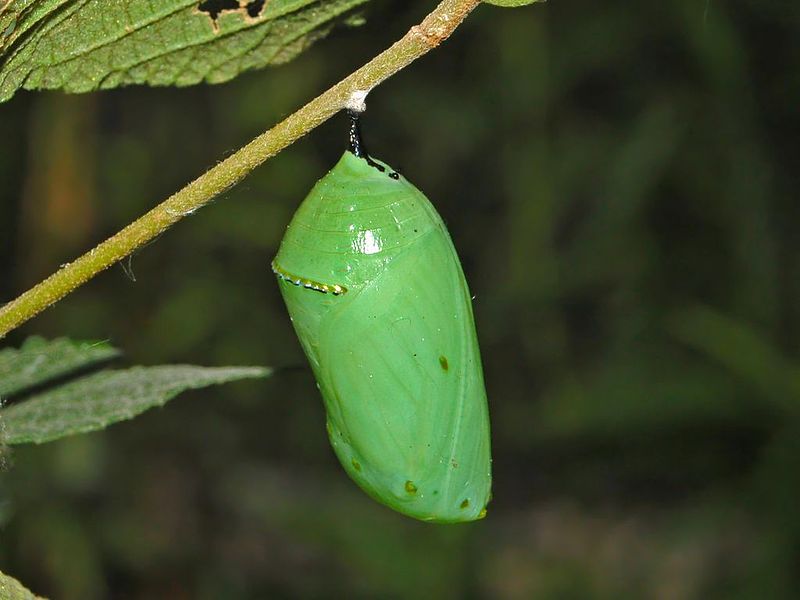
That hardens to form a chrysalis, a protective case. Inside the chrysalis, digestive juices break down a lot of the caterpillar’s old body. Using energy from stored up fats, a new body grows from the old one bit by bit.


Adult
After about two weeks, an adult monarch butterfly emerges from its chrysalis. It takes several hours for its wings to fully inflate and harden. Then it flies off to feed on nectar, the sweet liquid produced by flowers. It lives from two to eight weeks. During this time, the males and females mate. Then the females lay their eggs, starting the cycle over again.


Butterfly Inside
Experience what happens when a caterpillar turns into a butterfly. Cut out and color an adult monarch.

Then fold this up small and push it inside a balloon.
Have an adult partner blow up a balloon just enough to partly inflate it. Tie the neck to seal the balloon.

Cover the balloon with paper mache. To do this, first snip newspaper into strips about an inch (2.5 cm) wide and 6 inches (25 cm) long. Cut at least 25 strips. In a bowl, mix one-half cup flour with enough water to make a runny paste. Dip one paper strp into the glue mixture. Hold the strip over the bowl and slide between your thumb and fingers to remove excess paste. Smooth the strip onto the balloon. Repeat until the whole balloon is covered up to the neck. Smooth your fingers over the wet balloon. This will help seal the edges of the paper strips. Set the balloon in a clean, dry bowl. Turn frequently for a few hours to help it dry evenly. Leave overnight.

The balloon now represents the chrysalis inside which the caterpillar is changing into an adult butterfly. Use scissors to carefully snip into the balloon just below the neck. That will pop the balloon. It will deflate and separate from the inside of the paper mache. Carefully pull out the balloon. Open it and pull out the folded up adult. Unfold the adult slowly.

In real life, the adult butterfly’s body gives off a special chemical that helps break open the chrysalis. Then the adult crawls out and hangs upside down from its chrysalis. Its abdomen squeezes over and over, pumping fluid into the wings. The big wings slowly unfold. The butterfly flaps these wings while they dry and become strong. Then it’s ready to fly.


Scavenger Hunt

Now, go on an on-line scavenger hunt to track down the answers to these questions.


How can you help monarch butterflies?


Why is a viceroy butterfly colored to mimic a monarch butterfly?

Also, don’t miss the fun, interactive jigsaw puzzles on this site.


Where do monarch butterflies go to escape cold winters?
Watch the slide show at The Magic of Monarch Butterfly Migration


Also find out what is the longest any monarch butterfly has flown to date during its migration?


Wonder how monarch know where they’re going when they migrate?

Journey North’s Monarch Butterfly Migration Tracking Project reports
“This is a question that scientists are still working to answer. People working at the University of Kansas with Chip Taylor have shown that they use the sun, and also probably the earth’s magnetic field to know which way is south during the fall migration. But we don’t know how they find the specific spots in Mexico. Personally, I’m not sure that we’ll ever be able to answer this one—which I think is kind of nice. I like mysteries!”


If you like science mysteries too, after you finish reading Butterfly Tree you'll enjoy another of my books The Case of the Vanishing Golden Frogs: A Scientific Mystery (Millbrook, 2011). It’s the story of a real-life science mystery. Solving it meant the difference between life and death for Panama’s tiny golden frogs.

Saturday, September 10, 2011

Have A Pack Of Fun!


I’m delighted to share my book
Family Pack (Charlesbridge, 2011).


I have always been fascinated by wolves. I first had an opportunity to investigate the lives of wolves and wolf pack behavior when I wrote Growing Up Wild: Wolves (Atheneum Books for Young Readers, 2001).


Later, I interviewed experts who have spent long careers studying wolves in the wild to write Animal Predators: Wolves (Carolrhoda Books, 2004).


That was when I talked to Dr. Doug Smith, director of the Wolf Restoration Project at Yellowstone National Park. I’ll never forget the day he told me the story of Female 7, one of the first wolves set free in Yellowstone in March, 1995. Almost seventy years earlier, people trapped and killed wolves to eliminate this top predator from Yellowstone National Park.


All those years later, people realized, you can’t fool with mother nature. Every animal in an ecosystem has its role. Wolves helped eliminate sick, weak, and old animals keeping populations of grazing animals, like elk and deer, from becoming huge—too big for there to be enough food for them to eat.


What struck me as exciting was that the young wolf scientists called Female 7 didn’t choose to remain part of the pack people artificially created. She immediately set off into the wilderness on her own. Of course, no one knows exactly what she experienced or how she reacted. Family Pack is her story as I imagine it happened. The ending is known. Female 7 and Male 2 met. I suspect it was love at first sniff. When they mated and had pups, their family pack became the first naturally formed pack in Yellowstone. Scientists called it the Leopold pack. Over the years since then, the pack has grown into one of the strongest and largest packs in Yellowstone National Park. Female 7 and Male 2 are no longer living. However, their descendants continue to hunt the same territory Female 7 first claimed when everywhere she went hers were the first wolf prints to mark the ground in over seventy years.


You may want to share these activities before you read Family Pack. Or enjoy them as follow-up fun to reading this story.


1. Family Pack opens with a young female wolf heading off on her own into Yellowstone National Park. There are no other wolves anywhere around. Imagine if you were suddenly in a wilderness where you were the only human. How would you feel about that? What might you find exciting? What might make you feel frightened?


2. For wolves, the world is given shape and texture as much by scents as by colors and shadows. Close your eyes and have an adult partner guide you into different rooms of your home. Can you tell where you are just by what you smell?


Next, close your eyes while your adult partner cuts or peels an orange, an apple, or a banana. Sniff this fruit. Then have your partner hide the mystery fruit so you can’t look at it. Use crayons or paint to color a piece of paper, sharing your impressions of this fruit based solely on how it smelled. For example, rather than using orange to show that fruit choose a color to share how sweet it smelled and make the color dark or light to indicate whether the odor was strong or faint. Sniff the mystery fruit again and decide if you want to add additional colors to share additional impressions you get of this fruit.


Finish by showing your picture to another family member. Can they identify whether your picture shares an orange, an apple, or a banana? Then have your partner reveal the mystery fruit and let everyone share sniffing and tasting it.


3. At one point in the story, the young female thrusts her muzzle skyward and howls. Where she used to live, her voice would have drawn a chorus of other wolf voices and the arrival of her family. Try it! Have family members scatter throughout the house. Then you move to wherever you want your family to meet up. Start your family’s chorus by tipping your head back and giving a good loud howl. Have each family member join in with a howl that is slightly different than yours and thus uniquely their own. Each family member should also move toward you between howls. Repeat until your entirely family has found you.


Did howling help you find each other?
Did you find you were quickly able to identify each family member by their individual howl?
Imagine how you would feel if, like the female wolf in the story, you howled and your family never found you?


4. The young female wolf finally becomes able to catch prey to feed herself by practicing her hunting skills. Name at least five things practice has helped you learn to do better.


5. Finally, one day, the young female discovers she’s no longer the only wolf in her home territory. When she first meets the young male they sniff each other, rub heads, and lick muzzles. Like wolves, people have customs for greeting someone new? Think about how people you know respond to being introduced to someone.


What are the traditional customs for greeting new people in each of the following countries:
Cambodian
China
France
Grenada
India
Japan
New Zealand Maori
Singapore
Thailand
Tibet

If you're not sure about the local customs for greeting people, click on each of the following links to investigate.

Greetings in Other Cultures

How do greetings differ around the world?

Greetings Around the World


6. Family Pack has a very happy ending. I don’t want to spoil it by telling you what happens. You’ll need to read it for yourself. Once you do, decide why this is such a happy ending for the female wolf.


Don’t miss the websites and books to explore, plus the amazing wolf facts, that are supplied at the back of Family Pack.

YOUR FREE GIFT FOR THE NEW SCHOOL YEAR

  Are you an elementary school Teacher, Librarian, or Media Specialist?  Then SANDRA MARKLE  invites you to become a Markle Book Explorer. I...