Monday, May 20, 2024

HOST A SUMMER SCIENCE MAGIC PARTY!

 I'm known as Ms Whiz from my science magic show on TV in Atlanta, Georgia some years ago. I still share science magic during n-person OR virtual school visits. But you can invite your friends to a party and do some science magic too. 

Start with AIR POWER MAGIC!


This could get messy so work over a sink the first time. Even better try this outdoors. 

You'll need:
A study plastic plate
A paper towel
A sturdy plastic glass (juice size works best)

Fill the plastic glass nearly full of water. Fold the paper towel into fourths and place it on the middle of the plate. Next, turn the plate and towel over the cup like a lid. Hold the plate against the top of the cup with your fingers while you turn the whole system over.

Now the glass is on top. Be sure it is straight up and down. Hold on to the cup with the hand that isn't pressing up on the plate. Then--slowly--take your hand away from the plate. The plate won't fall and the water will stay inside the glass.

Air pressure makes this work because of air pressure. There is now more below the plate pushing up than inside the glass pushing down. Be sure and keep the glass straight or you will get a big splash!.


You'll need:
an empty 1 or 2 liter plastic soft drink bottle with a screw-on cap.
3 pushpins (the kind used to display things on a bulletin board)

Work outdoors or at the sink. Fill the bottle to the very top with water. Screw on the cap, making sure it's tightly sealed.

Next, stick the pushpins into the bottle, one at a time. Then have your adult partner hold the bottle by its cap while you carefully twist and tug out the pushpins. 

Surprise! If water leaks out at all, it quickly stops or slows to a tiny trickle.

The magic is that air pressure is at work again. Air doesn't simply push down, it exerts force in all directions. The force of the air pushing in on the water at the holes you made is greater than that of the water inside the bottle pushing out. 

What do you think will happen when you take the cap off the bottle? Try it--just be sure the bottle is over the sink. 😀

ONE MORE...

THE MAGIC FLOATING BALL


You'll need:
A blow-dryer
A Ping-Pong ball

Hold the blow-dryer with the nozzle aimed straight up. You may want your adult partner to do that for you. When the dryer is switched on to "high", place the ball in this column of fast-moving air so it's about 5 inches above the nozzle. Let go of the ball and quickly take your hand away.

As long as the air current is shooting striaght up, the Ping-Pong ball will float suspended above the dryer's nozzle.

This "magic" happens because fast-moving air has less pressure than more slowly moving air. So the Ping-Pong ball is trapped inside the column of fast-moving air. Here the ball is pushed upward by a jet of air with enough force to keep it from falling, but not enough to blow it any higher.

These science magic tricks are sure to be a party hit.

*By the way, be sure to come up with a cool name for yourself as the star of your party? 


Sunday, March 31, 2024

EYE SPY AN ADVENTURE!


It's story time!  Have you read WHAT IF YOU HAD ANIMAL EYES!? Level 2 Reader yet?
Children can either pick their own animal from the book or put the names of the featured animals on slips of paper and let them pick one to claim their animal eyes. The challenge is to imagine waking up one day and having that animal's eyes for one whole day. 


ASK THEM TO THINK AND IMAGINE: 
What adventure did you have? 
Did your animal eyes help you solve a mystery? 
Did those eyes help you be a hero? 
Did those animal eyes cause you any problems?

Then have them tackle this challenge: Write a story about having those animal eyes for a day in three short paragraphs: 
1. One to launch what happens. 
2. One for the action in the middle.
3. One for the conclusion. 

Even better if they draw a picture of themselves with those eyes.

Teachers: Why not wrap this activity up by building a class bar graph for favorite animal eyes.  You could color in bars on paper. Or have everyone line up and physically be part of a favorite animal eye graph. 
Put me in your graph as voting for my favorite animal eyes which are on pages 18-19.
I'd love to know your student-graph winners!
Please post in the comments.

Friday, March 8, 2024

Monday, February 19, 2024

GO BATTY FOR BATS!


Reading BATS: BIGGEST! LITTLEST! is the perfect way to start getting to know these amazing animals.  Then keep on exploring and learning about bats as you have fun with these activities.


Visit My Cave


What's it like to live like a bat?  

Cover a table on three sides with a blanket or paper to create a cave.  Have your family or a group of friends crawl inside your pretend cave with you.  While you're there with this group, think about these questions.

  1. Why is a cave a good home for small bats, like Mexican Free-tailed Bats? 
  2. Why do you think big bats, like Grey-Headed Flying Foxes, camp in the open in trees instead?
  3. What are some problems to sharing a cave with other bats?

What Good Are Bats?

Check out the hand-like structure of a bat's wings.

Try this to find out.  
Take a large bowl of popcorn kernels to the gym or outdoors to a paved area of the playground.  Work with friends to scatter 50 popped kernels on the floor or ground.  Count to ten. Then have people place two more popcorn kernels next to each original kernel.  This is as if the insect pests have multiplied.  


Now pretend you are an insect-hunting bat. Have four others pretend they are too.  While someone counts to five, have each “bat” pick up all of the insects they can carry.  Then have other children place two popcorn kernels next to each remaining kernel.  

Repeat these steps two more times, having “bats” collect “insects”.   Then have any remaining “insects” multiply.  

Now look at the results.
  • How much of an affect did the “bats” have on the “insect” population?
  • What limited how much of an effect the bats could have on the insects? 
  • What do you think would happen to populations of insect pests if there weren’t any bats?

Bats for Good Measure

Again, here's a good chance to see the arm and hand-like structure of a bat's wing.

The wingspan of the largest flying foxes can be up to 6 feet (about 2 meters).  Take string that length. Find at least 5 things about the same length.  What are they?  
Now, measure each of these things.  Find out how longer or shorter each is compared to a large flying fox’s wingspan. 
  • The teacher’s desk
  • The class’s two shortest students lying head to feet on the floor.
  • The classes two tallest students lying head to feet on the floor.
  • Your teacher’s armspan (from fingertip to fingertip with both arms stretched out)
The wingspan of the Bumblebee bat is 6 inches (15 centimeters).  Take a piece of string that length.  Find at least 5 things about the same length.  What are they?
Now, measure each of these things.  Find out how much longer or shorter each is compared to a Bumblebee Bat’s wingspan.


  • The smallest book in the classroom
  • Your pencil
  • The shoe of the student with the littlest foot
  • Your right hand span (from thumb to little finger with your hand spread wide).  Draw around your hand span on a piece of paper. Then compare to your bat wing measuring string.
I hope you've enjoyed this chance to dig deeper into BATS: BIGGEST! LITTLEST!  Check out the other books in this series from Boyds Mills:


Wednesday, January 10, 2024

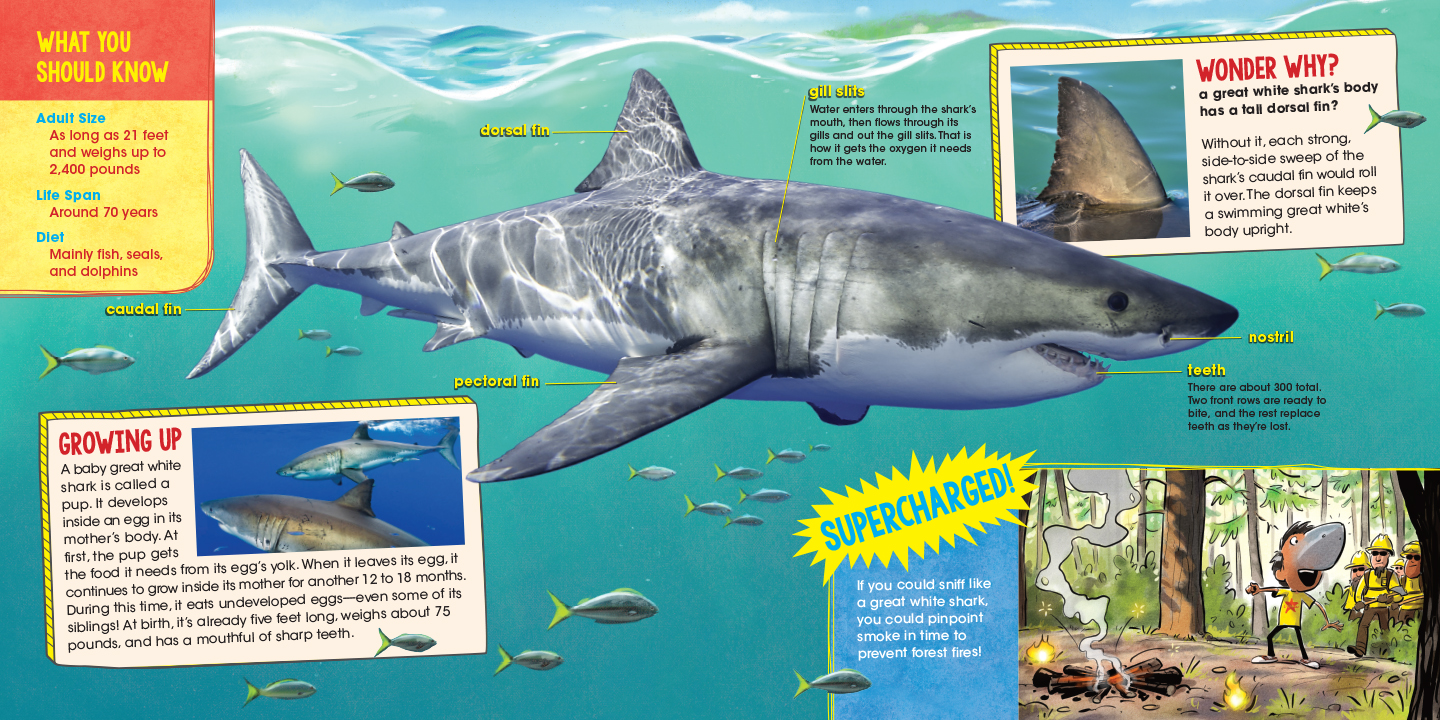
TAKE A BITE WITH GREAT WHITE SHARKS!


Size Matters to these hunters!

An adult Great White Shark never stops growing.  So it gets a little longer every year of its life.  They're born alive and about four feet (1.2 meters) long at birth.  One of the biggest kinds of sharks, adults often grow to be 20 feet (6 meters) long. Measure off a piece of string that length. Stretch it out on the floor and lie down next to it with your feet at one end of the string. Set something, like a pencil, across the string next to your head. Use a measuring tape to find out how many feet/meters shorter you are than a Great White Shark.

Now, find at least 3 things about the same length as a Great White Shark.  What are they?  Now find out how much longer or shorter each of the following things is compared to a Great White Shark.

*The class's two tallest students lying head to feet on the floor
*Your teacher 

Now peek inside my Scholastic book that features great white sharks to discover more.

READ AND DISCOVER!
How does a great white shark sense smells underwater?
click on image to make larger and read.
When would having a super sense of smell be GREAT?
When would having such a good sense of smell be BAD?
NOW CHECK OUT MORE
BONUS FACTS ABOUT GREAT WHITES:
Pups are on their own immediately after they are born.

Great White Sharks swim while sleeping. They breath through gills and need to move to push water through their gills.

Their bodies are not designed to let them swim backwards. So they can't backed up.


Thursday, November 16, 2023

WHAT IF YOU HAD ANIMAL FEET FUN!?


HOP! SKIP! STEP into WHAT IF YOU HAD ANIMAL FEET FUN!


LET’S STOMP


Have each child choose his or her favorite animal feet. 

Choose some foot stomping music and have the children spread out at least an arm’s length apart. Then turn on the music and have kids dance where they’re standing. 

NOW, imagine having kangaroo feet. Invite them to share how that might change how they do each of these activities:
  • Run a race
  • Take a bath
  • Play baseball


The Rest of the Story

The picture below shows only one moment in a story captured in WHAT IF YOU HAD ANIMAL FEET!?. Now imagine--and tell
  • What led up to the moment shown in the picture?

  • What is really happening in the picture?

  • How is this story likely to end?


NEW FEET


Now have children think about which of the animal feet in WHAT IF YOU HAD ANIMAL FEET!? they would like to have--for a day.

WHICH ONES? WHY?

Click to link to getting your very own copy of WHAT IF YOU HAD ANIMAL FEET!? coming soon also as a Level 2 Reader.


Sunday, November 5, 2023

CAN YOU MAKE SENSE OF THIS MYSTERY!


                 What is in the bag, Beau?


That is my cat, Beau, using his senses to try and predict what is in the mystery bag.


Challenge your Ss to do the same using their less used senses: hearing, smell, and touch. 

First, make up mystery bags. Lunch sized bags are fine. Use a marker to number each bag: 1, 2, 3, 4, 5. Make numbers big and in the middle of one flat side of the bag. Use scissors to poke a small hole next to the number on each bag

Put a handfull of one of these Mystery Items in the first  bag, fold the top over and staple shut. Repeat till  each item is sealed in its own bag. 

Mystery Items:
pennies
unwrapped peppermint candies
cotton balls
popcorn
M&M candies


Next, divide Ss into 5 small groups.  Tell everyone what 5 items are in the Mystery Bags. Give each group a bag. Challenge Ss to use their senses one at a time to collect information about what's in the bag. After each observation, challenge them to use their past experiences and these observations to try and identify the mystery object inside their bag.

Have Ss use their sense of hearing first.  Have them shake the bag and listen. 

Next, have Ss gently poke and squeeze the bag. What do they observe using touch? Does that make them want to change their earlier prediction about what's inside the bag? If so, what do they now think the mystery item might be?

Challenge Ss to use their sense of smell this time and repeat the process.  They'll need to make observations, consider what they may have smelled in the past that had that scent, and decide if they want to change their prediction.

Have each group write down the bag number and which item they believe is in that mystery bag. 

Now, have groups switch bags and repeat the observation tests. 

Once every group has examined all 5 bags, allow Ss to open the bags and see what is inside.

Were they right? Which sense helped most?

AND how did past experiences and knowledge about the mystery objects help!?

Beau guessed right! His mystery bag held Kitty Treats.  Now, he's enjoying a book and a nap.

CLICK HERE and I'll read one of my books.


YOUR FREE GIFT FOR THE NEW SCHOOL YEAR

  Are you an elementary school Teacher, Librarian, or Media Specialist?  Then SANDRA MARKLE  invites you to become a Markle Book Explorer. I...