Friday, February 26, 2016

CELEBRATE INTERNATIONAL POLAR BEAR DAY WITH A SPECIAL BEAR


While you're celebrating International Polar Bear here's the story behind my book about one special polar bear. Waiting For Ice (Charlesbridge) actually started, as many of my books do, while I was doing research for another book and--WHOA!--I discovered an incredible true story.


I live and write by the rule that 99.9 percent of my research information must come directly from experts who are working firsthand on the subject.  That sometimes takes me to very interesting places, like the South Pole.  Or, at the very least, it lets me talk with experts on the phone--sometimes via satellite while they're in remote places.


So while writing Animal Predators: Polar Bears (Lerner),
I had the chance to talk to Dr. Nikita Ovsyanikov. 


 Since 1990, he's spent every Arctic summer on Wrangel Island, studying polar bears.  That's no easy task. Let me set the scene for you. 


This is an aerial view of Wrangel Island during the summer and during the winter. 

Wrangel Island in winter.

Wrangle Island in summer.
It's never an easy place to live. The island is North of the Arctic Circle.  It's a rugged, windswept, storm-scoured island about half the size of Rhode Island surrounded by frigid seas.


It's no wonder the island has features with such names as Unexpected River and Doubtful Spit.  Check out this website to find out more about Wrangel Island.


So why go there to study polar bears? It's because that's the place hundreds of polars bears are stranded every summer.  All winter long, polar bears roam solo or a mother travels with her cubs. The bears take advantage of icebergs and raft-like ice floes to rest in between hunting seals, beluga whales, and other sea creatures.  Polar bears are good swimmers, but they can't swim indefinitely. So when the sea ice melts, they haul out.  They're stuck wherever they land until, once again, the sea crusts over with ice.  Because Wrangel Island is one of the few available land masses in prime polar bear territory, as many as 600 bears are stranded there every summer.

Imagine the fights that break out as the bears compete for wind-sheltered resting spots and food.  Finding something to eat isn't a big problem while the island is also home to colonies of migratory birds, such as black bellied plovers and red knots, raising their young or walruses stopping by to rest.  However, those animals leave around September. 

Normally the sea ice returns in September so the polar bears leave the island about the same time as their prey.  However,  global warming has delayed sea ice formation to as late as November.  Then the polar bears are trapped, waiting for ice.  Eventually, the only food source on the island is scraps, like the remains of a whale that washed ashore and dead birds. 


Nikita shared the amazing story of what happened in 2002, a year when the polar bears had to wait until well into November for the sea ice to return.   He said, "One day, I spotted two young cubs alone on a narrow spit of land.  The cubs were small, undoubtedly only born that year, but no mother bear arrived to feed or protect them."

Nikita watched the cubs on the spit for six days. Each day, they screamed for their mother, paced nervously, and bravely lunged to drive away adult bears that came too close. The mother bear never returned, though.  On the sixth day, Nikita discovered there was only a single cub, a young female, stood alone on the spit.  Adult polar bears will attack and kill orphaned bears so Nikita guessed that's what happened to the one cub.  He also worried what might happen to the survivor.
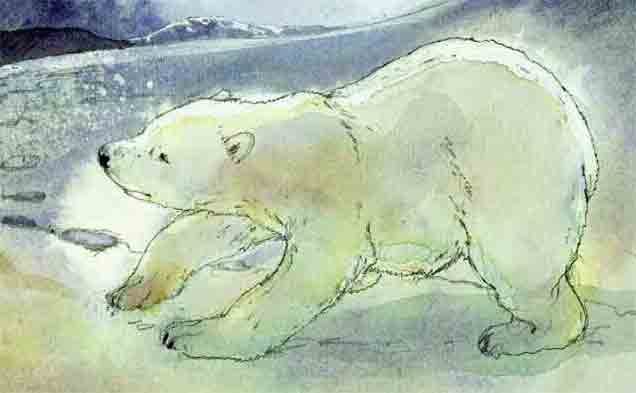

The orphaned cub left the spit and Nikita searched for it each day as he studied the polar bears.  He watched her bravely fend off attacks from adult bears and steal a few bites of dried walrus skin.  One day, she managed to get a dead bird all for herself.  Seeing her fight to stay alive, Nikita nicknamed the cub Tuff.  Watching Tuff became his favorite past time.  Then one day Tuff surprised him by coming to the cabin where he lived on the island. His rule was to only watch the animals, but when he caught Tuff peering longingly into the window of the storage room where he kept his supply of reindeer meat his heart melted. 

Nikita said, "To me it was like watching a child suffer.  I couldn't do it. I thought I'd give her a few happy moments in what would surely be a very short life."

 Then he kept on feeding her from time to time because the sea remained ice free that year until 
well into November. 


When the ice finally returned. Nikita packed up to head home too. The day before he left,  he gave Tuff a farewell gift--a whole reindeer carcass.  So she ate and ate.  Then, very full, Tuff waddled out onto the ice, lay down, and fell asleep. 


In the morning, Nikita looked for Tuff one last time but couldn't find her. Because the ice was broken up, he guessed Tuff must have ridden out to sea aboard a floating ice raft.  He was sure that was the last he'd ever see of the polar bear cub.  What chance could she possibly have of making it through the winter without a mother to teach her to hunt or to catch food for her. 


What a shock he had, when he came back to Wrangel Island that next summer. 

He'd barely settled in when a young adult polar bear plodded up to his cabin.  Nikita said, "I'd spent so many hours looking her in the face and taking her picture, I knew at once this was Tuff."

Tuff seemed to recognize Nikita too. All that summer, whenever she ran into him on the island, she came close and didn't run away.  She also didn't come looking for a handout. She'd learned to survive on her on. Nikita happily watched Tuff growing bigger. When the ice returned that year, she left healthy and strong.


The rest of Tuff's life remains a mystery because Nikita has yet to see her return to Wrangel Island again. He says, "I like to think Tuff's alive and well and raising cubs of her own." 

I like to think she is too.   

Tuesday, February 23, 2016

IT'S LEAP YEAR--SO HOP TO IT!


Yes, it's LEAP YEAR! What better reason to think about frogs and toads.


I value these amphibians for all they do for us:

Eating lots of insects like mosquitoes and flies that would otherwise become pests.

Being food for lots of animals, such as birds, snakes, foxes, and some fish like pike and bass. (Okay--not an angle the frogs and toads might want to consider but valuable all the same.)


Plus frogs and toads are just plain cool. Like the fact that they have a sticky tongue attached to the inside front of their mouth and it rolls out in less than a second to snag a bug. Or that to swallow their eyes sink to push food down their throats.

Here are some more fun facts about frogs and toads:


A group of frogs is called an army. A group of toads is called a knot or a nest.


Only male frogs croak. They may also whistle or bark. In some kinds of toads both the males and females make noise.

Some toads play dead or puff up to look bigger, if threatened by a predator.


Toads have special glands on the back of their heads. If the toad is stressed, these give off poison that can kill a predator that bites it. It won't cause warts on people but it's best to not touch toads or wash well if you do.


No matter how many times you kiss either a frog or a toad, though,
it won't turn into a prince.

And here are some fun frog and toad activities to enjoy in honor of 2016 being LEAP YEAR.

Hopping Off The Page

Compare the toads in each of these two book. To do this, first read these books.

Fiction:  Frog and Toad Together by Arnold Lobel (Harper Collins, 1972)


Faction (fictional story where all the facts are true): Toad Weather by Sandra Markle (Peachtree Publishing, 2015)


1. What is one way the toads in these two books are different?

2. What is one way the toads in these two books are alike? 

3. What time of day does the fiction story take place? How about the faction story?

4. Look at the pictures of toads in each book. What's one way the toads look alike? What's one way they look different? 

Say It In A Poem


Create a cinquain (say sin-cane) about a frog or toad. This is a kind of poetry first created by the American poet Adelaide Crapsey about 100 years ago. 

This kind of poem is just 5 lines long. It usually tells a short story about something and follows this format--2,4,6,8.2. That means
The first line has just 2 syllables (pronounced beats)
The second line has 4 syllables.
The third line has 6 syllables.
The fourth line has 8 syllables.
The fifth line has just 2 syllables again.

What's more there's a flow to the short story shared in a cinquain. It goes like this:
Line 1 = Name the subject
Line 2 = Describe it
Line 3 = Show some action
Line 4 = Share some feeling about it
Line 5 = Give a quick conclusion


For example


Bull frog.
Green and hungry.
Sees a fly and snags it.
What a master garden insect
hunter!


BONUS Fold A Hopper

Visit this website and follow the directions to fold a paper frog. Then push on the frog to make it hop off a starting line. Measure how far it hops. 

Try your paper hopper on 3 different kinds of surfaces, such as carpeting, wood and tile. On which does your frog hop the farthest? How much farther is the longest hop than the shortest?


And one more--take this photo and saying as a story starter.

Okay--because LEAP YEAR has one extra day--here's one more thing to do on this longer-than-usual-month. Read THE CASE OF THE VANISHING GOLDEN FROGS aloud. 
Did science detectives solve this mystery? 
Did they save the frogs?


Monday, February 22, 2016

MEMORIES OF MAGNITUDE


Five years ago,  my girlfriend and I went to lunch in Christchurch, New Zealand and, like these two women became survivors. Today, with all my Christchurch friends, I remember that day and what followed.

I'd written about major earthquakes but until that day I'd never experienced one.


At 12:51 on February 22, 2011 a 6.3 magnitude earthquake struck Christchurch, New Zealand. 


It was shallow--less than three miles deep--and for all those people going about their lives on the earth’s surface, it was world-changing. 


Reporters said the dust from the collapsing buildings and whole hillsides exploding could be seen for miles. I don’t doubt it. But, at the time, dust was the farthest thing from my mind. I was in Christchurch when the earthquake struck. All I was thinking about was staying alive.

I’d already been through the September 4, 2010, Christchurch earthquake. It was as different as night and day from this one. For one thing, its epicenter, the point where sections of the earth slid past each other, was about thirty miles away and about ten miles deep. 


That quake also happened in the early hours of the morning when most people were home in bed. That time, I awoke to a roar like a violent windstorm. 


Then the house began to tremble and the shaking became increasingly violent until it again slowed and, finally, stopped. It was scary, and some buildings were destroyed, but no one died. Along with everyone else who lived through that quake, I thought, “Well, I’ve lived through the big one. Thank heavens my house only suffered minor cracks, and my husband and I are safe.”


Four months on, Christchurch was in recovery mode. The rubble had pretty much disappeared and new buildings were springing up. 


The fact that a few streets still had residents living with port-a-potties was considered absolutely outrageous. After all, the earthquake was an event for the history books—over and done. 


An earthquake was definitely the farthest thing from my mind on February 22nd. My girlfriend was here visiting from out-of-town, so we went out to lunch at one of my favorite Christchurch restaurants. We ate sandwiches and laughed a lot. Then our after-lunch coffees arrived, I picked up my cup, and the restaurant exploded. Everything in the restaurant was instantly shrapnel. Food and dishes launched and smashed. Tables and chairs launched and crashed. People were airborne, screaming, falling, gasping, landing, crumpling. Windows shattered.

I’ve been told the quake only lasted twenty seconds. It felt like hours. It’s hard to believe so much damage could happen in only twenty seconds. Just around the corner from me—less than half the length of a football field away—part of the front of the two-story shopping mall crashed onto the sidewalk, seriously injuring a number of people and crushing a mother and her baby.


Less than a mile away, in the very center of Christchurch, tall buildings pancaked down and parking garages collapsed. In just one-fifth of a minute, 750 buildings became rubble. 


The iconic Christchurch Cathedral’s bell tower tumbled into a heap. 


The fabulous stained glass windows of Knox Centre Church were reduced to sparkly bits. 


Two city buses lay crushed under heaps of bricks, power lines snapped, school buildings cracked, bridges split, and flat roads were transformed into roller coasters. 


Besides that damage in the center of the city, in surrounding suburbs, 100,000 homes suffered significant damage and 10,000 more were completely destroyed. Many people were seriously hurt. Nearly two hundred people died.


But I didn’t know the extent of the damage surrounding me when I fled the restaurant while the earth was still jerking with strong aftershocks. I only knew the nightmare wasn’t over, and I wasn’t yet safe. The world around me was chaos. Piles of shattered glass gleamed in the sunlight outside buildings like weird snowdrifts. Confused people staggered into the street and ambled aimlessly. 


Others sat on the curb weeping. Still others, like my girlfriend and I hugged, and hurried toward the parking lot. 


We skirted bubbling gray mud spouting from cracks in the ground, but the mud was everywhere. The going was difficult. It was also hard to hear—hard to think—over the sounds of chaos and the shrill blaring of many sirens.


That day, the drive home that normally took forty minutes took four and a half hours. Aftershocks repeatedly rocked the car. An especially strong aftershock briefly had the car airborne. Again, that event probably barely lasted a second but it seemed much longer as I gripped the steering wheel. Time was strangely out-of-whack in this alien world. 

My girlfriend came home with me. Her husband and their two sons and their families arrived  later that night. I was blessed that my home again suffered very minor damage and we had electricity, clean water, and working toilets. We settled down to a surreal existence that became a struggle to obtain supplies that were in short supply. Neighbors shared with neighbors to keep going. It was nearly a week before our visitors could safely go home or on to other families living outside of Christchurch. 


Japan’s major quake just a few weeks later took this event out of the world's spotlight. For those of us who were there, the memory dimmed but will never be extinguished. 

Five years on and rebuilding continues. Recovery, in so many ways, continues. The recent Valentine's Day Quake that registered 5.7 on the Richter Scale was a vivid reminder and jolted barely soothed nerves. The city I loved no longer exists. 


But today, as I remember that fateful day five years ago, I also want to remember Christchurch the way it was--an amazingly beautiful city. 

The first time I saw Christchurch just after Christmas in 1996. I’d flown in from Atlanta, Georgia late at night and gone straight to my hotel. The next morning as the New Zealand summer sun rose bright and hot, I walked across a bridge, over a beautiful meandering river, and into the city. I felt like Dorothy in the Wizard of Oz, opening the door from her black and white world into the spectacular, brilliantly colored world of Oz. It was a vibrant, culturally rich city that would become my home for fourteen years.


Most of those buildings are gone now but the people who I count as dear friends--the people who are the heart of Christchurch--remain. I'm thinking of them today, remembering the past, and hoping for strong, safe beautiful future for Christchurch.

Sunday, February 14, 2016

GET READY--February 28th is NATIONAL TOOTH FAIRY DAY!

This photo is from the Clutter Free Classroom blog. Who reports: "It is currently the most popular book in our class library." SMILE!!!
National Tooth Fair Day is coming up on February 28th. So I want to thank a few of the many teachers and librarians who have helped me share WHAT IF YOU HAD ANIMAL TEETH!? And, of course, the rest of the series including the newest book, WHAT IF YOU HAD ANIMAL EARS!?


Here are a few of the blogs I know are sharing one of my books--WHAT IF YOU HAD ANIMAL TEETH? (Scholastic, 2013).  I hope those of you who are also sharing this book or know of blogs with activities based WHAT IF YOU HAD ANIMAL TEETH? will Comment. I'd love the sites I'm sharing here to grow, and grow, and grow. SMILE!

Definitely check out Science For Kids: Adventures of An Elementary School Science Teacher by Sue Cahalane.

Sue has created activities based on my book WHAT IF YOU HAD ANIMAL TEETH?  She shares patterns for four kinds of teeth (narwhale, elephant, camel, tiger) kids can use while imaging themselves with different kinds of animal teeth.  She also shares worksheets for an animal classification activity based on this book.


At Oceans of First Grade Fun by Yolanda Arnold. You'll find patterns for the other kinds of animal teeth in this book. Like her students, your children can try their hand at a little opinion writing answering these questions:
  • If you could have teeth like any one of the animals in this book, which would you choose?
  • Why would you like to have that kind of animal teeth?


Of course, like the book, also challenge children to think about what's great about having human teeth.

At First Grade W.O.W. (Windows On Wonder) Nancy Vandenberge shared her entire class with their animal teeth.  These kids also examined some cool REAL teeth Nancy brought in to share.

"I love collecting fun things for our science center.  I have a bull skull which includes many of his teeth, a small deer jawbone, and a good friend just gave me an elk skull with teeth.  We had an amazing time examining each one. " Nancy Vandenberge

And what a great chance for children to think about how each animal's teeth are just right for what that animal eats.

Definitely don't miss Homeschool Share. Scroll down to Science Activity 7 and Animal Teeth
You can download a  worksheet with wonderful photos your children can use to match animal teeth to just the right animal.
Or go to Science Kids: Fun Science & Technology For Kids.  There your students can play an interactive game. They're challenged to drag teeth to the right animal, including a human, and click on EAT.  Making a mistake is as much fun (and interesting) as getting it right.


And you'll find more fun at Teach Mentor Texts.  There, Jen gives the book five hearts and suggests this activity.

"Writing Prompts: Imagine that you did have animal teeth - as if they were a super power. What could you do with animal teeth that would help you in your daily life? Write a story where you show how you would put your animal teeth to use. Choose two animals from the book to compare and contrast. How do they use their teeth in similar or different ways?"

Also check out one more activity called One Big Bite. It has lots of action-packed, mind-building fun for your students to chew on. And if you have a special way you're sharing WHAT IF YOU HAD ANIMAL TEETH? with kids please click on Comment and share. That'll let us all share the SMILES!!

And while you're sharing how you're building activities around WHAT IF YOU HAD ANIMAL TEETH? here are some more teacher created activities you won't want to miss.

Lesson Plan Resource File--Animal Teeth--Estimating Length

Tuesday, January 26, 2016

GUESS WHO GOES TO SNOW SCHOOL!

It's SNOW LEOPARD CUBS, of course! You can visit and see what happens in my book Snow School.

Snow School was inspired by my love of cats, especially wild cats. There are none more fascinating than snow leopards.  These wild cats are so rare there are believed to be as few as 3,500 left in the entire world.  


As always, when I want to learn more about a wild animal I go exploring. That’s how I came to spend a winter in Antarctica, the experience that inspired me to write A Mother’s Journey, a story about what female emperor penguins do while the males hatch out the eggs. 


Dr. Tom McCarthy with snow leopard cub
(courtesy of Panthera Snow Leopard Trust)
Sometimes, though, I just can’t get to the places I need to go to explore firsthand.  Then I track down experts who have been able to go to those places and studied the wild animals I want to write about.  That was the case with Snow School.  I had the pleasure of interviewing Dr. Tom McCarthy who has spent many years climbing the high, rugged mountains of Pakistan in order to learn about the life and behavior of snow leopards.  


To see where snow leopards live and the story of Snow School takes place, go on-line to find out about Pakistan (in red on the globe).  Also search for information about the Hindu Kush Mountains, the setting for the story.  This habitat is one of the harshest on earth and requires the cats to be able to chase fast prey downhill over 
very rocky terrain.


Even during his many years studying snow leopards Dr. McCarthy shared that he only had a chance to watch a few downhill chases as snow leopards caught prey.  He said, “Once, I was lucky enough to see a mother have two cubs with her while she hunted.”  


Dr. McCarthy guessed these cubs were in training.  Snow leopard cubs spend two years with their mothers learning to survive on their own.  That inspired me to wonder what lessons snow leopard cubs need to learn in order to be successful in the extreme conditions of their home habitat.  

For one thing, as soon as they’re big enough, snow leopard cubs travel with their mother. That way they get a close look at the features of their environment.  And they learn the shortest, safest routes to take. 


To get a feel for what the snow leopard cubs are learning, go to your local park or playground with a parent or adult partner.  Take along a pencil and a notepad.  Draw a map of the area.  Use symbols to mark any key landmarks, like fountains or statues, big trees, or benches.  Next, study the map with your partner and plan the fastest, safest path to use to travel across the mapped area.  Then use a watch to time how long it takes you to run across the area following your chosen path.  Afterwards, revisit the map and decide if another way might be easier or safer.  Time your new route.


The snow leopard’s habitat is really a high desert with very steep terrain.  When these cats hunt, they have to chase down prey animals, like ibex, capable of running down steep, rocky slopes without falling.  And they have to pounce at just the right moment to stop their prey without going over a cliff.


Snow leopards do have some natural built-in advantages. One is a very long tail.  Dr. McCarthy reports that a snow leopard’s tail is all muscle and that it’s heavy. He said, “It must even be heavy for the snow leopard.  In snow, I’d see a mark where  a cat would start to drag its tail after every two or three steps.  So holding up its long tail must be tiring.”


Having such a long tail is worth the effort, though, when the snow leopard starts to run.  It swings its tail back and forth and that helps it stay balance while twisting and turning.  To get a feel for how its tail helps a snow leopard stay balanced, try this.  Stand on one foot with your hands at your sides.  Then repeat standing on one foot but this time stretch out your arms and move them forward and backward.  

Snow leopards also have big feet that act like snowshoes, helping them walk on top of fluffy snow.  In fact, Dr. McCarthy reported a snow leopard’s feet leave very round footprints because their feet are about as wide as they are long (about four to five inches in both directions.) Measure the length and width of one of your feet.  How much longer is your foot that it is wide?  And, just for fun, figure out how much longer your foot is than a snow leopard’s.


These cats also have a lot of fur around their toes and the pads of their feet to shield them from the ice and snow.  Like housecats, snow leopards have retractable claws.  They put these out to help them climb and to stop themselves from skidding.


Dr. McCarthy reported that once a snow leopard catches prey it needs a safe place to eat—safer than on a steep mountainside.  Dr. McCarthy said, “I’ve watched a snow leopard drag a big goat that weighs as much, if not slightly more, than the cat does.  And it drags this prey uphill.”   

Imagine pulling something that weighs as much as you do.  Now, imagine doing it the way a snow leopard does.  This cat bites to grab its prey.  Then it drags this weight between its legs.  This is another behavior snow leopard cubs learn by being copycats, doing what their mother does.


 From an early age, the cubs learn the smell of what’s good to hunt because their mother brings home prey.  See if you’ve learned to identify your food by its scent.  Have an adult partner blindfold you. Then have them hold each of the following five food items, one at a time, under your nose for you to sniff.  Test your scent IQ on the following: peanut butter, orange juice, mustard, cheese, and ketchup. 

You might be surprised to learn that snow leopards usually only get a chance to catch big prey about once a week.  So when it does, the cat is likely to stay by its prey and eat as much as 25 pounds of meat a day for two to three days.  How much is that.  Weigh a plate.  Then put the food you’re going to eat for dinner on that plate and weigh it again. Subtract the weight of the plate to see how much your meal weighs.  How many of those meals would you have to eat to equal what a snow leopard eats when food is available?


Can you guess what snow leopards do after such big meals?  You’re right!  They sleep.  Like lions, tigers, and housecats, snow leopards sleep most of the day to save their energy for hunting.  

I hope you enjoy reading Snow School.  


CREEPY SPIDER FUN!

Can You Solve The   Mysteries? The spiders below have been divided into 2 groups--those that alike and those that are different. What makes ...