Sunday, March 11, 2012

DON'T THROW OUT THE TRASH!


It can be a lot of fun to help keep the earth healthy. One way you can help is by taking a second look at everything you think is trash. Maybe instead of sending it off to a landfill, your trash can become art, a toy, or something to help your local wildlife. Here are some ideas to get you started. You'll definitely discover that recycling and using up things instead of throwing them out can be FUN!


From What Happens Next: 2 by Sandra Markle (Longstreet Press, 1996).
Turn Old Newspapers into A Birdhouse

Just follow these steps and birds will soon be moving in. First, blow up a balloon and tie the neck. In a plastic bowl (or a milk jug with the top half cut off) mix a half cup white glue with a half cup of water.

Use scissors to cut strips of newspaper about 2 inches wide. Start with about 50 strips.


Check with an adult to see where it's okay for you to work because the next step is going to be messy. And definitely wear old clothes. Then, one-by-one dip strips of newspaper into the glue, wipe off any excess by squeezing between your fingers, and press the strip smoothly onto the balloon. You'll need to cover all of the balloon, including the neck so you may need to take time out to wash up and cut more paper strips. Let the balloon dry completely. Then repeat. Do this until you've built up four layers covering the balloon.

Now, find out what small birds commonly live in birdhouses in your area. Check on-line or in bird books to find out what diameter hole you'll need to have in your birdhouse for your local guests to move in. Have your adult partner use a utility knife to cut a door that's just the right diameter about 3 to 4 inches above the bottom. That will pop the balloon. So remove the balloon pieces from the inside. Then have your adult partner do one more thing.

Working outdoors, have your adult partner spray a coating of water-based enamel inside the house. (This paint is available at home supply stores). This will help make the house waterproof. Dr. Mimi Shepherd, an avian veterinarian, reports water-based enamel is safe for birds once it's been allowed to dry for several days).

Also have your partner use pointed scissors to drill three drainage holes in the round bottom of the birdhouse. And they'll need to attach a toggle bolt to the pointed end and twist on a wire loop to hang the birdhouse.

Finally, back indoors you can use a paintbrush and acrylic paint to decorate the outside of the birdhouse. Top that with a coat of varnish to make the house waterproof.


From Exploring Winter by Sandra Markle (Atheneum, 1984)
Make A Bottle Diner For Birds

Invite the birds to your house for dinner. To make this bird feeder, you'll need a two liter soft drink bottle with a screw on cap, ball point pen, scissors, string, three wire garbage bag ties (or pipe cleaners), and an aluminum pie plate.

Cut off the bottom of the bottle. Set it on the middle of the pie pan and draw around it.

Cut four large scallops along the cut off edge of the bottle. This will allow a flow of bird seed.

Poke holes in the pan on two opposite sides of the circle you drew.

Poke holes in two opposite sides of the bottle.

Attach the bottle to the pan with the ties. Twist the third tie to each of the other two ties on the bottom of the pan. This will securely anchor the bottle to the pan.

Cut off a piece of string 18 to 36 inches long. Poke two holes in the neck of the bottle. Loop the string through the holes and tie the ends in a knot. That will form a loop you can use to hang the bird feeder.
Pour seed into the bottle through the bottle mouth until the feeder is about half full. Put the cap on the bottle.

Once your bottle bird feeder is ready, ask an adult to hang it in a tree or somewhere you can easily watch from a window. You'll also need your adult partner to help you add seed to the bottle feeder as needed. Once you begin to feed the birds, they will depend on you to keep the food coming. If the weather gets cold and snowy in the winter where you live, your bird feeder may be the best diner in the area.

As you watch your bird feeder, see if you can discover the answers to these questions:

  • What time of day do the birds most often come to eat?
  • Do the birds come more or less often if the weather is stormy?
  • Do the birds usually feed one at a time or in groups?
  • Which birds chase others away? (You may need to search on-line or in bird books to identify the birds that come to your feeder.)

From What Happens Next: 2 by Sandra Markle (Longstreet Press, 1996).

Shoot Water Blasters
You can turn empty plastic bottles with screw-on caps, such as water or soft drink bottles, into a kind of squirt gun--a water blaster.

First, take the cap off the bottle. Have an adult partner help you put a hole in the center of this cap. Using an oven mitt, they'll need to hold the tip of a slim steel nail (a fourpenny nail) in a candle flame for about ten seconds. Then, working over a stack of old magazines, they'll need to immediately press the hot nail tip straight down on the center of the inside of the cap. That will make a small hole in the cap.

Then you can fill the bottle with water and screw on the cap to create your Water Blaster. Take your Water Blaster outdoors and squeeze to fire. Refill as needed. Build up your blasting skills by aiming at plastic cups set on something that is about waist high.


  • How far away can you be and still strike your target?
  • Does the amount of water in the Water Blaster make a difference to its blast power?


From The Kids' Earth Handbook by Sandra Markle (Atheneum, 1991)
Play A Game of Jug Ball

This game will turn empty milk jugs into a great game. Collect six milk jugs and rinse them out. Use scissors to cut the body of the jug, transforming it into a scoop (like the one in the picture). Next create a ball. Use an old dishwashing sponge. Dampen it so it's bendable. Bend it in half and anchor this shape with several recycled rubber bands.

Now, to play jug ball, stand in a circle. Stand close together. Then take three steps back. Toss the sponge ball from player to player. Start by going around the cirlce. Then have the player doing the tossing call the name of the player who must catch the ball. Any player who fails to catch the ball collects one letter of the word "Oops." When all four letters are collected by the same person, he or she must drop out of the game. The winner is the person remaining when everyone else has spelled "Oops."


Just remember, for the earth's sake,
conserve, recycle, and use it up!

Sunday, March 4, 2012

PLAY BALL!


Spring isn't far away and with that comes BASEBALL.  So here's a bunch of activities to get you ready to throw out the first ball of the season.

Do Cold Balls Bounce Less?


In 1965, the Detroit Tigers accused the Chicago White Sox of refrigerating the balls used by their pitchers.  Should a team care if their batters are pitched ice-cold balls?  You can find out.

Slip at least three baseballs  (five is even better) into a plastic grocery sack to keep things clean and chill them in a refrigerator for an hour.  While you're waiting think about how chilling changes other things, like pancake syrup or butter.  Then conduct this test to find out the cold facts.


Work outdoors on a paved area or indoors on a smooth, hard surface (after checking with an adult). Have someone hold a measuring stick straight up with the starting end of the scale on the floor.  Drop the balls one at a time from the top of the stick.  Be sure someone is watching closely to check exactly how high each ball bounces.  Write down each ball's bounce height. Divide by the number of balls tested to find the average bounce height.

Next, spend five minutes warming up the balls using anyway you can think of to do the job safely, such as holding the balls in warm hands or even setting them on a hot water bottle.

Then repeat the bounce test with the warmed balls.

Were the warm balls better bouncers?  They should be.  

How far a baseball travels when a batter strikes it depends on two things: the amount of energy transferred to the ball by the bat and how quickly the elastic material making up the ball snaps back, pushing away from the bat.  When a bat strikes a ball, it compresses the baseball to about one half of its original diameter. Wow! Think about that the next time you watch a batter connect with a ball.


For all those inquiring minds who'd like to know how this historic event effected the game, here's the rest of the story.  Before this event, Major League home teams used to supply game balls to the umpire one at a time throughout the game. So the home team's pitchers could be given chilled balls. Worse, according to the White Sox, the Tigers baked the balls given to their team's pitchers. That meant the Tigers were slugging hot balls.  To end the squabble, today, Major League rules require the home team to supply all the baseballs to be used during the game two hours before game time.

The Balls Have Changed--But Not Much
In the past 100 years, baseballs have only changed in one way. In 1974, cowhide replaced horsehide as the baseball's covering.  Otherwise a baseball is exactly the same, today, as it always was.

There's a cork core inside a rubber ball surrounded by nearly a quarter mile of woolen yarn, a winding of cotton/polyester yarn and a leather jacket sealed with 108 stitches (not one more or one less).

The finished ball must weigh between 5 and 5.25 ounces (141 and 148 grams) and be between 9 and 9.25 inches (22 and 24 centimeters) around.
This CT-scan lets you peek inside a real baseball to see its parts.
Don't you love the unique way technology lets us look at things?


Find The Sweet Spot


You'll need a wooden bat and a hammer (either a real hammer or a wooden mallet) for this activity.  Your job is to find the one special spot on the baseball called the sweet spot.  It has that name because striking a baseball with exactly that spot on the bat will make it travel farther than striking it at any other point.  That happens because striking the ball at the sweet spot causes the least amount of vibration within the wooden bat.  And that means the greatest amount of energy will be transferred to the ball.  So where is the sweet spot?

Have a partner grab the end of the bat's handle and let the bat hang straight down. Use the hammer to tap the bat gently near its fat free end.  Then repeat tapping the bat gently at points closer and closer to the handle.  Usually striking the bat at the sweet spot will produce a slightly different sound.  The person holding the bat should also feel less vibrations when the bat is struck at the sweet spot.


To be precise, measure about six inches (15 centimeters) up from the fat end of the bat.  That's where the sweet spot is usually located.

When a Major League player strikes the ball at that
spot, it's not uncommon for the ball to leave the bat
traveling 100 miles (160 kilometers) per hour.


In the past, Major League ballplayers tried to make balls travel farther by swinging heavy bats.  Home run hitting king Babe Ruth regularly used a 42 ounce (1,190-gram) bat. Sometimes, he even used one that weighed 52 ounces (1,474 grams).


Today, though, players have decided they can knock balls farther by swinging faster. So they are opting to use lighter bats--ones weighing 32 or even 28 ounces (907 or 793 grams).


Play the Original Game

This is a photograph of a game of rounders being played in 1913.

Before there was baseball, people in England played a game called rounders.  Follow these directions, to play a game of rounders. Then decide how it's similar to today's game of baseball. And how it's different.

To play rounders, first vote on how many players to have on a team--any number will do.  It's not even necessary for the two competing teams to have the same number of players.

Next, vote on whether to have three or five bases.  Once outdoors, space out the bases in a circle. They can be as close together or as far apart as you choose. The pitcher will stand in the center of this circle. The batter from the opposite team will stand at one of the bases. The other players on the pitcher's team will be in the field to try and catch the batted ball and tag the batter before he circles the bases.

Now, play ball.  Each player gets only one chance at bat.  The winning team is the one with the most players to have rounded all the bases.  By the way, in the original game, runners weren't tagged out. They had to actually be struck with a ball tossed at them.

You might be interested in knowing that in the very early days of baseball, players were given four strikes before they struck out.


Check out these websites for even more baseball fun.

The Baseball Hall of Fame   Great information about the Hall of Fame players, trivia about baseball, and Frequently Asked Questions about the game.

Black Baseball League  A place to explore the period of baseball's history when black players had their own league.

Atlanta Braves  A site to find tips from pros, interviews with players and much more. I shared this team's site because I lived in Atlanta for many years and still cheer for the team.  However, you can find information about your own favorite team at MLB.com

Monday, February 6, 2012

Waiting For Ice--The Inside Story


Waiting For Ice (Charlesbridge) actually started, as many of my books do, while I was doing research for another book and--WHOA!--I discovered a special story.


I live and write by the rule that 99.9 percent of my research information must come directly from experts who are working firsthand on the subject.  That sometimes takes me to very interesting places, like the South Pole.  Or, at the very least, it lets me talk with experts on the phone--sometimes via satellite while they're in remote places.


So while writing Animal Predators: Polar Bears (Lerner),
I had the chance to talk to Dr. Nikita Ovsyanikov.


 Since 1990, he's spent every Arctic summer on Wrangel Island, studying polar bears.  That's no easy task. Let me set the scene for you.


This is an aerial view of Wrangel Island during the summer and during the winter. 

Wrangel Island in winter.

Wrangel Island in summe
It's never an easy place to live. The island is North of the Arctic Circle.  It's a rugged, windswept, storm-scoured island about half the size of Rhode Island surrounded by frigid seas and miles from anywhere people would find comfortable.


It's no wonder the island has features with such names as Unexpected River and Doubtful Spit.  Check out this website to find out more about Wrangel Island.


So why go there to study polar bears? It's because that's the place hundreds of polars bears are stranded every summer.  All winter long, polar bears roam solo or a mother travels with her cubs. The bears take advantage of icebergs and raft-like ice floes to rest in between hunting seals, beluga whales, and other sea creatures.  Polar bears are good swimmers, but they can't swim indefinitely. So when the sea ice melts, they haul out.  They're stuck wherever they land until, once again, the sea crusts over with ice.  Because Wrangel Island is one of the few available land masses in prime polar bear territory, as many as 600 bears are stranded there every summer.

Imagine the fights that break out as the bears compete for wind-sheltered resting spots and food.  Finding something to eat isn't a big problem while the island is also home to colonies of migratory birds, such as black bellied plovers and red knots, raising their young or walruses stopping by to rest.  However, those animals leave around September.


Normally the sea ice returns in September so the polar bears leave the island about the same time as their prey.  However,  global warming has delayed sea ice formation to as late as November.  Then the polar bears are trapped, waiting for ice.  Eventually, the only food source on the island is scraps, like the remains of a whale that washed ashore and dead birds.


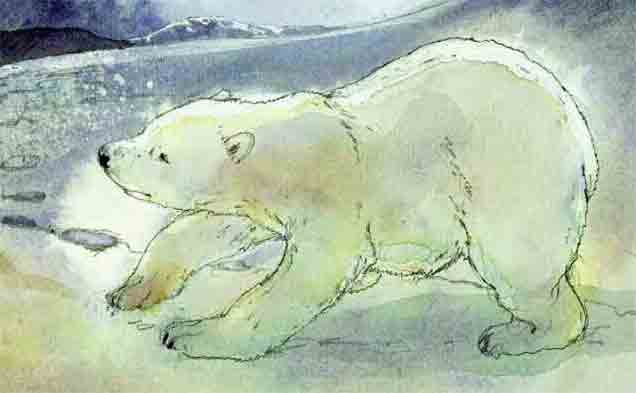
Nikita shared the amazing story of what happened in 2002, a year when the polar bears had to wait until well into November for the sea ice to return.   He said, "One day, I spotted two young cubs alone on a narrow spit of land.  The cubs were small, undoubtedly only born that year, but no mother bear arrived to feed or protect them."

Nikita watched the cubs on the spit for six days. Each day, they screamed for their mother, paced nervously, and bravely lunged to drive away adult bears that came too close. The mother bear never returned, though.  On the sixth day, Nikita discovered there was only a single cub, a young female, stood alone on the spit.  Adult polar bears will attack and kill orphaned bears so Nikita guessed that's what happened to the one cub.  He also worried what might happen to the survivor.


The orphaned cub left the spit and Nikita searched for it each day as he studied the polar bears.  He watched her bravely fend off attacks from adult bears and steal a few bites of dried walrus skin.  One day, she managed to get a dead bird all for herself.  Seeing her fight to stay alive, Nikita nicknamed the cub Tuff.  Watching Tuff became his favorite past time.  Then one day Tuff surprised him by coming to the cabin where he lived on the island. His rule was to only watch the animals, but when he caught Tuff peering longingly into the window of the storage room where he kept his supply of reindeer meat his heart melted.

Nikita said, "To me it was like watching a child suffer.  I couldn't do it. I thought I'd give her a few happy moments in what would surely be a very short life."

 Then he kept on feeding her from time to time because the sea remained ice free that year until 
well into November. 


When the ice finally returned. Nikita packed up to head home too. The day before he left,  he gave Tuff a farewell gift--a whole reindeer carcass.  So she ate and ate.  Then, very full, Tuff waddled out onto the ice, lay down, and fell asleep.


In the morning, Nikita looked for Tuff one last time but couldn't find her. Because the ice was broken up, he guessed Tuff must have ridden out to sea aboard a floating ice raft.  He was sure that was the last he'd ever see of the polar bear cub.  What chance could she possibly have of making it through the winter without a mother to teach her to hunt or to catch food for her.


What a shock he had, when he came back to Wrangel Island that next summer. 

He'd barely settled in when a young adult polar bear plodded up to his cabin.  Nikita said, "I'd spent so many hours looking her in the face and taking her picture, I knew at once this was Tuff."

Tuff seemed to recognize Nikita too. All that summer, whenever she ran into him on the island, she came close and didn't run away.  She also didn't come looking for a handout. She'd learned to survive on her on. Nikita happily watched Tuff growing bigger. When the ice returned that year, she left healthy and strong.


The rest of Tuff's life remains a mystery because Nikita has yet to see her return to Wrangel Island again. He says, "I like to think Tuff's alive and well and raising cubs of her own."

I like to think she is too.   

Wednesday, January 11, 2012

It's Time For Winter Fun


Some animals can't wait for it to snow.


And some can't wait for there to be lots of ice.


So those animals would think you're lucky to have cold winter weather.

You definitely can have a special kind of winter fun.  These activities will give you ideas for ways you can make the most out of living where winter is--well--wintery!


Go On A Scavenger Hunt


You might find maple seeds like these.

Try to find:

  • Something older than you are
  • Something younger than you are
  • A seed
  • Something rough
  • Something smooth
  • Something that will change in the spring
  • A bird feather


How wet is the snow? 


 Find out. In an average snowfall, ten inches (25 cm) of snow melts down to one inch (2.5 cm) of water. How much drier or wetter is your current snowfall.


You'll need a can at least ten inches (25 centimeters) tall with straight sides. Try to collect your snow sample shortly after the snow stops falling. Fill your sampling can, but don't pack the snow.


Next, take the can indoors and let the water melt.

Try keeping a record of each new snowfall for the rest of the winter. Which months had the wettest snow? If you keep your tracking going, find out how one year's snowfalls compare to another.


By the way, I spent one winter at McMurdo Station in Antarctica. I'd always heard that, if temperatures were below -60F (-51C) boiling water thrown into the air would freeze before it hit the ground. I had a chance to test it because that winter the temperatures dropped as low as -129F. The boiling water immediately turned into tiny sparkling ice crystals.


This is a great winter time read--don't miss it.

The Winter of the Blue Snow


Have you ever heard of Paul Bunyan? He was a giant of a man--and I mean a real giant, so the stories go. There are tales about the lumber camp he ran in the far North.
One of those is about the winter of the blue snow.

Nobody knew why the snow was blue that winter. Some say it was because it was so terribly cold. How cold was it? It was too cold for thermometers to measure. The men each had sixteen blankets to sleep under, but they still couldn't keep warm. Shot Gunderson, the head woodchopper, slept under forty-two blankets one extra cold night. There were so many blankets he got lost trying to find his way out from under that huge pile. In fact, it took him three whole days to uncover himself. The poor fellow nearly starved to death before he made it to the cook shake.

Not that eating was easy once you got to the table. When Hot Biscuit Slim, the cook, set coffee out to cool, the steaming brew froze so fast that the ice was hot. The men had to eat with their mittens on because the hot biscuits froze solid before they went the distance from plate to mouth.

Conversations around the bunkhouse were slowed down mightily that super-cold winter. Words froze as fast as they were spoken. Piles of icy words had to be heaped behind the stove because nobody could tell what had been said until the words thawed out.

About the time summer was due, the weather got even colder and the blue snow kept on falling. Snowdrifts piled up two hundred feet (60 meters) deep. Elevators were built just to carry the men from the bunkhouse to the surface. To log the trees, Paul had to scoop out holes and lower his men down to the forest.

What you don't believe this wintery tale?
Make up one of your own packed full of all the things that might happen if it was super cold and the snow was super deep.

One of the most famous blizzards ever recorded was during the winter of 1888. Thirty to forty inches (75-100 cm) of snow and ice was dump on the Northeastern United States. That was before snowplows and entire cities were helpless for weeks. Before the blizzard was over four hundred people had died.

Collect Snowflakes


While no two snowflakes are ever exactly alike (as far as anyone knows), they are all hexagone--six-sided crystals. Snowflakes take several main shapes.

If you want to catch some snowflakes, chill a clean glass slide or a small mirror in the refrigerator. Take the cold glass outside and allow a few flakes to collect on it. You may need a magnifying glass to see the snowflakes if they are very small.

To preserve snowflakes so you can even take them inside with you you'll need a can of plastic spray--the kind artists use on chalk drawings.


Chill the spray along with the clean glass slide. Carry the glass slide outside on a piece of cardboard. This keeps your body heat from warming the glass. Spray the glass lightly with the plastic coating. Let snowflakes collect on the glass. Take the preserved snowflakes inside and let the plastic coating completely dry (about fifteen minutes).

Check out this book about Wilson Bentley.
His photos of snowflakes became world famous.


Now you can examine the snowflakes with a magnifying glass or a microscope if you have one. No need to rush. These snowflakes will stay crystal-clear forever.


Go Tracking

Duck Tracks

Rabbit Tracks


When the ground's covered with snow, it's the perfect time to collect animal tracks like these.


Take along an adult partner and a digital camera. Snap photos of any animal tracks you find. Back home, look on-line to match the prints you found to the animal. Google images is one good source to check out.

While you're at it try to decide what the animal might have been doing at the time it left its tracks. Was it running or walking? How do you think you could tell? Try making tracks of your own running and walking and observe the difference. It's even more fun if you find overlapping sets of tracks from different animals. Now, make up a story for what might have happened. Was one animal there first? Was one animal chasing the other? There's a new story in every set of snow tracks you find--even if they're people footprints.

Treat The Birds


You can get a good look at birds that spend the winter in your neighborhood, if you invite them to dinner. An easy treat to make is a peanut butter pinecone. Loop a string around the top of a pine cone and tie a knot. Next, smear peanut butter on the cone and roll the cone in birdseed. Then have an adult partner hang the pinecone where birds will be able to perch and eat.

Now, keep watch. Use bird books and search on-line to help you identify the birds visiting your bird diner. Also, answer these questions:
1. What time of day do the birds come to eat?
2. Do the birds come more on stormy or sunny days?
3. Do the birds take turns and feed one at a time? Or do they compete to eat?
4. Which birds usually chase other birds away?

Create a colorful bar graph to share the data you collect about your dinner guests.

Remember, to replace your pinecone with a fresh treat from time-to-time to keep the dinners coming back for more.

Saturday, December 17, 2011

Spider Fun And Games


My Arachnid World Series, featured a number of spiders:

Black Widows: Deadly Biters

Orb Weavers: Hungry Spinners

Fishing Spiders: Water Ninjas

Wolf Spiders: Mothers On Guard

Jumping Spiders: Gold-Medal Stalkers

 Tarantulas: Supersized Predators


The following games and activities will let you have fun investigating spiders.

Can You Solve The Mystery?

The spiders below have been separated into two groups--those that have a common feature and those that don't. What feature do the spiders in Group 1  share?


Group 1
Group 1

Group 2
Group 2


Did you guess that the feature the spiders in Group 1 share is having two middle front eyes that are bigger than their other eyes?

Now brainstorm at least three other features  you could use to regroup the spiders into groups: those that share the feature and those that don't.
Here are two possibilities to get your creative juices flowing:
1. Group 1: Those that are light colored; Group 2: Those that aren't.
2. Group 1: Those that look hairy; Group 2: Those that don't.


Having  two big middle eyes is a feature jumping spiders share.
  • Jumping spiders depend on their eyesight to catch prey, the animals they kill to eat. They have eight eyes: four looking forward, two on top of their head, and two toward the back of their cephalothorax (head and chest-like area).  
  • Jumping spiders can spot prey as much as twenty body lengths--about 15 inches (38 cm) away.
  • Jumping spiders can move their big middle eyes separately to look in two different directions at once. 
Find out more about jumping spiders in Jumping Spiders: Gold-Medal Stalkers


Make A Toy Spider


Make a toy spider you can hang from the ceiling to watch dangle and spin.


You'll need four pipe cleaners (the bigger the better), a paperclip, a rubber band, and a 36-inch (91 cm) piece of string or package ribbon.

1. Place the four pipe cleaners side-by-side and twist together in the middle. Spread the ends of the pipe cleaners apart and bend to form the spider's eight legs.

2. Bend one end of the paperclip around the middle of the toy spider. Hook one end of the rubber band over the other half of the paperclip.

3. Tie one end of the string to the free end of the rubber band.


With an adult partner's permission and help, attach the free end of the string to the ceiling, the top of a bookcase, or the top frame of a doorway. Then enjoy watching your spider in action.


  • A spider's silk comes from nozzlelike parts called the spinnerets on the end of its abdomen.
  • Silk starts as a gooey liquid. It becomes a solid strand when the spider fastens it to something--even its own leg--and pulls.
  • All spiders spin silk to stay safe as they travel. As they move around, they trail a silk safety line. From time to time, the spider produces a bit of sticky silk to glue this line to the surface it's crossing. That way it the spider falls or leaps and doesn't jump quite far enough, it doesn't crash. It can climb back up its silk line and keep on going.


Orb weaver spiders do much more with their silk. They use it to build a web snare that can catch flying insects without breaking. Then the spider shoots bands of silk over the prey. She keeps on spinning while her feet turn the prey around and around. Wrapped up, the prey can't escape. And it can't easily bite and injure the spider.

The strands of an orb weaver spider's web are tougher than Kevlar, the material used to make bulletproof vests.


 Find out more about orb weaver spiders and their silk traps in Orb Weavers: Hungry Spinners.


Go On A Web Hunt

Go with an adult partner to look for spider webs in you're area. Look for the following:


1. A web between two branches

2. The biggest web (Take along a tape measure and, with your partner's help, measure the diameter or distance across the web. Be careful not to touch or damage the web)

3. The smallest web (Measure this one too.)

4. A web that looks neat and tidy

5. A very messy-looking web

6. A web with trapped insect prey


If you have a camera, take photos of the webs you find. Print out your favorites to display or make into a book. If you and your adult partner would like to capture and preserve a web, be sure there isn't a spider on the web. Then follow the directions on this website.


Eat Like A Tarantula


Some spiders, like tarantulas, are able to crush and partly break up the prey they catch. However even the biggest tarantulas can't chew and swallow chunks of food. They bring up digestive juices that break down their food and change it into a gooey liquid. Then the tarantula sucks this food in.

To get a feel for eating like a tarantula start with a fruit-flavored gelatin. Work with an adult partner to follow the directions to prepare the gelatin. Chill until the gelatin is solid. Next, scoop a spoonful of the solid gelatin into a glass. Use a spoon to mash and break the gelatin into small pieces. Then pour enough apple juice into the glass to cover the gelatin. The apple juice will act like digestive juice. The gelatin should now be a gooey liquid. Use a straw to drink this liquid treat.

The biggest tarantulas, like the female pinkfoot goliath pictured with the snake, are so big the distance across their outstretched legs is as big as a dinner plate. Being big lets a tarantula hunt and catch prey too big for most spiders to safely tackle.  The snake in the picture is a two foot (0.5 meter) long fer-de-lance snake. Not all tarantulas are giants, though. The Paloma dwarf tarantula has a leg span just over an inch (2.5 cm) across.  Of course, that's still bigger than many kinds of spiders.

Find out more about tarantulas in Tarantulas: Supersized Predators


YOUR FREE GIFT FOR THE NEW SCHOOL YEAR

  Are you an elementary school Teacher, Librarian, or Media Specialist?  Then SANDRA MARKLE  invites you to become a Markle Book Explorer. I...